Home -> Law Blog Directory -> Intellectual Property Law Blogs -> Seattle Trademark Lawyer
(866) 635-2689 for Personal Injury or (866) 635-9402 for Criminal Defense
Find a Local Lawyer
Divorce (866) 635-6190
Personal Injury (866) 635-2689
Criminal Defense (866) 635-9402

Intellectual Property Law
: Seattle Trademark LawyerIf Parody is Exempt from Dilution, Why isn't It Exempt from Infringement?
By Michael Atkins
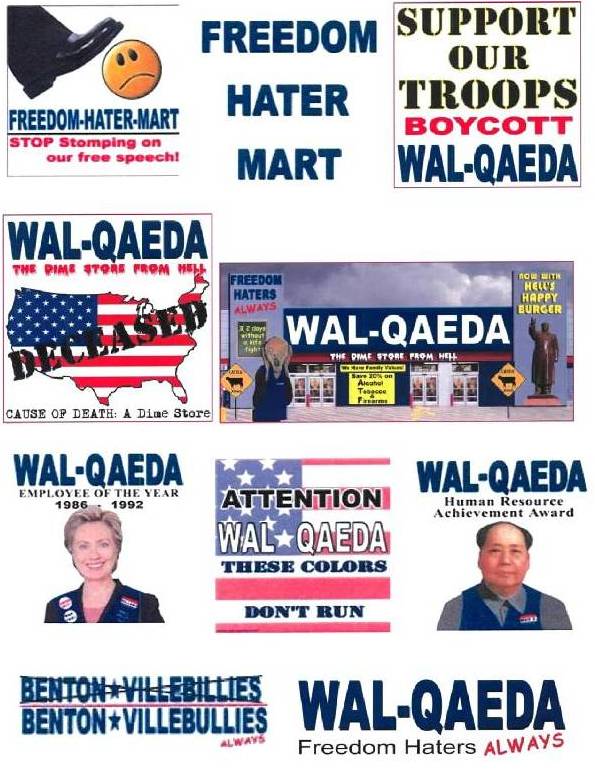 Not commerical, so no dilution: Charles Smith’s WAL-QAEDA parody
Discussing parody in my Advanced Trademark Law Seminar.
I’m stumped on one point.
In a number of cases involving the parodic use of a trademark, courts apply likelihood of confusion analysis to infringement claims. Successful parodies do not cause a likelihood of confusion, so they do not infringe trademark rights.
Analyzing dilution claims, however, courts in the same cases often treat parodies as noncommercial speech. For that reason, they conclude parodic uses are exempt from dilution claims.
In Smith v. Wal-Mart Stores, Inc., 537 F.Supp.2d 1302 (N.D. Ga. 2008), for example, the court concluded Charles Smith’s use of WAL-QAEDA was not likely to confuse consumers with Wal-Mart’s trademarks, so Wal-Mart’s infringement claim against him could not stand. With respect to Wal-Mart’s dilution claim, the court found WAL-QAEDA succeeded as a parody because it communicated Mr. Smith’s negative feelings about Wal-Mart. “Thus, Smith’s parodic work is considered noncommercial speech and therefore not subject to Wal-Mart’s trademark dilution claims….” In other words, Mr. Smith’s parody did not trigger the dilution statute because it was noncommercial.
Similarly, in MasterCard Intern. Inc. v. Nader 2000 Primary Committee, Inc., 2004 WL 434404, *9 (S.D.N.Y.), the court found Ralph Nader’s use of MasterCard’s trademarks in a political ad that spoofed MasterCard’s “Priceless” advertising campaign was not likely to confuse consumers, so it dismissed MasterCard’s infringement claim. With regard to its dilution claim, the court concluded the Nader campaign’s use of MasterCard’s mark was “political in nature, not within a commercial context, and is therefore exempted from coverage by the Federal Trademark Dilution Act.” Again, noncommercial use did not trigger the statute (though this time it was because the ad was political, not because it was a parody).
The answer’s probably sitting there in McCarthy on Trademarks, but if a use that’s deemed noncommercial does not trigger the dilution portion of the Lanham Act, why does it trigger the infringement portion of the Lanham Act?
I realize the dilution portion of the statute expressly excepts parodic and noncommercial use — and infringement finds its roots in common law —but if my use of a trademark is deemed to be noncommercial, why do I have to go through likelihood of confusion analysis to determine if such use nonetheless infringes a trademark owner’s rights? Seems like a finding that my use is noncommercial would be the same “Get Out of Jail Free” card for infringement that it is for dilution.
Anyone willing to tell me why it’s not?
Full post as published by Seattle Trademark Lawyer on March 01, 2011 (boomark / email).
Parody is a Protected Form of Speech
Targets of criticism seek to shut down Internet sites that poke fun
The Princeton Review
$2.6 million settlement reached in patent infringement case.
Spike Lee and Showtime
Settlement reached in script copyright infringement lawsuit.
Trade Secrets
Razorsight agreed to pay $4.5 million settlement in infringement lawsuit.
Underground Piping
Insituform Technologies awarded $4.5 million patent infringement settlement.
Zantac Patent
GlaxoSmithKline and Cypress Pharmaceutical settle patent infringement dispute.
DNA Products
Agilent Technologies pays undisclosed patent infringement settlement to Invitrogen Corporation.

#1 Online Legal Resource

On 08-25 at 15:46PM
Acute perpendicular parking #NYPD #NYFD
On 08-18 at 22:18PM
Parallel parking gone bad. Too much gas UES NYC
On 08-18 at 21:41PM
UES NYC
On 08-18 at 21:25PM
Twitter suspends journalist critical of broadcast partner's coverage on dubious grounds @guyadams #nbcfail #twitterfail
On 07-30 at 17:57PM
Model example of 1st Amendment suppression by the People of New York City's Michael Bloomberg #OWS #NYPD
On 07-12 at 21:07PM
AG Holder lackadaisical on Operation in our Sites domain name seizures & RIAA lobbied free speech suppression @dajaz1
On 06-08 at 22:44PM
Why is the Catholic Church going to court over Obama contraception policy? @NewYorker commentary
On 05-31 at 10:08AM
Monks sue Louisiana for right to sell caskets made from forrest destroyed by Katrina
On 05-31 at 07:47AM
Are the abortion ultrasound laws headed for the Supreme Court?
On 05-15 at 21:52PM


Brody: All Charities are Property-Tax Exempt, But Some are More Exempt than Others
Caplin & Drysdale Shifts Tax-Exempt Guns to NASCAR-Rival
SOI Releases 2007 Tax-Exempt Bond Data
Helping Tax-Exempt Hospitals Keep Their Tax-Exempt Status
Wikipedia's British Cousin, Wikimedia UK, Ruled Not Tax Exempt
IRS Examines <1% of Exempt Organizations Each Year


 |
|
Contact Us | About Us | Celebrity Law Blog |
Our Partners | Disclaimer
| Law Blog Directory
| Law Jobs
| Law Tweets
| Oil Spill Video
All original material © 1999-2011 by USLaw.com. All other material, including Blog Directory feed content, are © by their respective copyright holders. |