Home -> Law Blog Directory -> Constitutional Law Blogs -> Blog of Rights
(866) 635-2689 for Personal Injury or (866) 635-9402 for Criminal Defense
Find a Local Lawyer
Divorce (866) 635-6190
Personal Injury (866) 635-2689
Criminal Defense (866) 635-9402

Constitutional Law
: Blog of RightsThe Surveillance Memos, and a Suggestion for Jack Goldsmith
By Jameel Jaffer, Center for Democracy
As I noted in a previous post, the two Bush administration surveillance memos we obtained last Friday are very heavily redacted. They're interesting nonetheless.
The first memo, written by Office of Legal Counsel lawyer John Yoo in November 2001, contends that the president has authority as Commander in Chief of the Armed Forces to disregard the Foreign Intelligence Surveillance Act (FISA), a statute that 'purports' (Yoo's word) to regulate government surveillance. It also contends that Congress doesn't have the power to regulate the president's authority to gather intelligence for national security purposes. And it contends that intelligence gathering in support of military operations 'does not trigger constitutional rights against illegal searches and seizures.' These are radical and insupportable claims, but they're consistent with the claims that Yoo made in other OLC memos.
The second memo, written by Jack Goldsmith in May 2004 is more surprising, but to understand why, you need to know a little bit of recent history.
President Bush first authorized the National Security Agency's warrantless wiretapping program in October 2001. Under that program, the NSA intercepted some Americans' international communications without first obtaining warrants from federal judges (i.e., without complying with FISA). The warrantless wiretapping program was exposed by the New York Times in December 2005 and was the subject of an ACLU lawsuit.
But the warrantless wiretapping program wasn't the only surveillance program that President Bush authorized in October 2001. When President Bush authorized that program, he also authorized 'a number of new, highly classified intelligence activities' about which we still know almost nothing. Yoo wrote a series of memos, including the November 2001 memo mentioned above, to provide these activities — collectively called the 'President's Surveillance Program', or 'PSP' — with a veneer of legality. In 2003, though, both Yoo and his boss, Jay Bybee, resigned from Justice Department's Office of Legal Counsel. Their successors, Goldsmith and Patrick Philbin, disagreed with the memos that Yoo had written. Goldsmith and Philbin shared their concerns with others, and in March 2004 several senior Justice Department officials almost resigned when the president reauthorized the PSP without making adjustments to it. Goldsmith wrote his memo after the White House agreed to modify the PSP.
Given that background, what's striking about the memo that Goldsmith wrote in May 2004 is how similar it is to the one that Yoo wrote in November 2001. Like Yoo, Goldsmith contends that the president has authority as Commander in Chief to disregard FISA. Like Yoo, Goldsmith contends that Congress doesn't have the power to regulate the president's authority to gather intelligence for national security purposes — certainly not during wartime, and probably not during peacetime, either. And like Yoo, Goldsmith suggests — without fully committing to the proposition — that intelligence gathering in support of military operations does not trigger the Fourth Amendment at all. Here's footnote 30 from Goldsmith's memo:
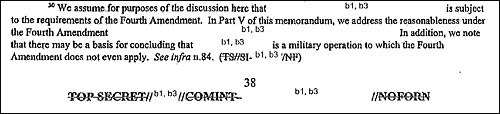 |
Goldsmith may have disagreed with Yoo's November 2001 memo, but one wouldn't know that from reading Goldsmith's May 2004 memo. To the contrary, the unredacted portions of the memos are remarkably similar.
I say 'the unredacted portions,' though, because, as noted above, large swaths of the Goldsmith memo are redacted, and, except for eight sentences, all of the Yoo memo is redacted. In a note on his blog, Goldsmith suggested on Friday evening that the redactions are unfair or misleading — he wrote that 'An understanding of my views and actions requires reading the memorandum and other classified documents in their entirety, which is not possible today.' If Goldsmith really thinks that some of the redactions are unwarranted, perhaps he might consider pressing the Obama administration to release the memo with fewer redactions.
Learn more about surveillance: Subscribe to our newsletter, follow us on Twitter, and like us on Facebook.
Full post as published by Blog of Rights on March 25, 2011 (boomark / email).
Construction Crane
Universal Concrete and Mi-JACK pay $1.6 million worker's compensation settlement after crane crushes an employee.
Drive Through Discrimination
Jack-in-the Box pays undisclosed racial discrimination settlement to two customers.

#1 Online Legal Resource

On 08-25 at 15:46PM
Acute perpendicular parking #NYPD #NYFD
On 08-18 at 22:18PM
Parallel parking gone bad. Too much gas UES NYC
On 08-18 at 21:41PM
UES NYC
On 08-18 at 21:25PM
Twitter suspends journalist critical of broadcast partner's coverage on dubious grounds @guyadams #nbcfail #twitterfail
On 07-30 at 17:57PM
Model example of 1st Amendment suppression by the People of New York City's Michael Bloomberg #OWS #NYPD
On 07-12 at 21:07PM
AG Holder lackadaisical on Operation in our Sites domain name seizures & RIAA lobbied free speech suppression @dajaz1
On 06-08 at 22:44PM
Why is the Catholic Church going to court over Obama contraception policy? @NewYorker commentary
On 05-31 at 10:08AM
Monks sue Louisiana for right to sell caskets made from forrest destroyed by Katrina
On 05-31 at 07:47AM
Are the abortion ultrasound laws headed for the Supreme Court?
On 05-15 at 21:52PM


Jack Goldsmith on the Constitutionality of the Libya Intervention
Jack Goldsmith's Advice to the Next President on Legal Policies and the War on Terror
Jack Goldsmith on Investigating the Bush Administration
Does Jack Goldsmith Prefer Barack Obama to Dick Cheney


 |
|
Contact Us | About Us | Celebrity Law Blog |
Our Partners | Disclaimer
| Law Blog Directory
| Law Jobs
| Law Tweets
| Oil Spill Video
All original material © 1999-2011 by USLaw.com. All other material, including Blog Directory feed content, are © by their respective copyright holders. |