Home -> Law Blog Directory -> Legal Commentary Blogs -> TalkLeft
(866) 635-2689 for Personal Injury or (866) 635-9402 for Criminal Defense
Find a Local Lawyer
Divorce (866) 635-6190
Personal Injury (866) 635-2689
Criminal Defense (866) 635-9402

Legal Commentary
: TalkLeftWhy Not One Drug for Lethal Injections?
By Jeralyn
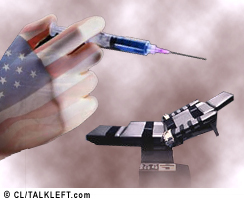
The New York Times reports that states are rescheduling executions now that the Supreme Court has ruled in Baze v. Rees that the three drug cocktail used by states does not violate the 8th Amendment's prohibition against cruel and unusual punishment.
The Fourth Circuit has a new challenge on its hands.In Emmett v. Johnson, Emmett is arguing that the way in which Virginia administers the drugs is unconstitutional because unlike Kentucky and other states, it doesn't allow enough time for the first drug, which anesthetizes and renders the inmate unconscious, to take effect before administering the other two drugs which cause pain. To make it worse, when there seems to be a problem with the first drug, rather than giving more of the drug, Virginia increases the doses of the pain-causing second and third drugs, but not the first.
In its brief (available here pdf) Emmett's lawyers make the argument that there is a painless way to kill someone with just one drug: [More...]
the best and most feasible alternative procedure to eliminate this risk is to move to a protocol that uses only a single, massive dose of thiopental, pentobarbital, or some other barbiturate to cause death.
While the issue was raised in Baze, the Supreme Court refused to consider it because it hadn't been raised or considered by the lower courts in Kentucky.
As to the three drugs,
Under the three-drug method, the first drug is designed to anesthetize the inmate, the second to paralyze him, and the final drug to stop the heart and bring on death. That is the general approach used by all but one of the states that still have the death penalty.
Emmett also argues that in Virginia, a review of the 70 cases of execution by the three drug cocktail shows many instances of incompetence:
The brief argued that the evidence shows that members of the state’s execution team “have performed incompetently,” including a lack of understanding of how the drugs work, mistakes in inserting IV needles to deliver the drugs, team members’ inability to properly observe the inmate during the process, a lack of more dosage of thiopental if IV failure occurs, and a ban on all spoken communications among the team members as the process goes forward.
The first inmate scheduled for execution following Baze v. Rees is Earl Lynd in Georgia. His execution date is next Tuesday.
Arguments in the Emmett case will be heard Wednesday, May 14.
Full post as published by TalkLeft on May 03, 2008 (boomark / email).
Mitchell Report Summary
Report on Steroid Drug Use in Major League Baseball by Senator George Mitchell
Drug Manufacturer Rebates
Caremark Corp. agrees to pay $38.5 million settlement after convincing doctors to switch drug brands.
Heparin Injections
alleging syringes were contaminated with bacteria.
Dobutamine Hydrochloride Injection
Labeling Errors Prompts Recall of 250 mg/20 ml Injections
FDA Issues Warning Regarding Topical Ibuprofen Drug Products
Topical Ibuprofen Drug Products FDA Issues Warning Letters
Digitek Recalled
the heart drug allegedly contains double the medication that it should
VA Medical Centers
Admit to Drug Overdoses, Software Glitches

#1 Online Legal Resource

On 08-25 at 15:46PM
Acute perpendicular parking #NYPD #NYFD
On 08-18 at 22:18PM
Parallel parking gone bad. Too much gas UES NYC
On 08-18 at 21:41PM
UES NYC
On 08-18 at 21:25PM
Twitter suspends journalist critical of broadcast partner's coverage on dubious grounds @guyadams #nbcfail #twitterfail
On 07-30 at 17:57PM
Model example of 1st Amendment suppression by the People of New York City's Michael Bloomberg #OWS #NYPD
On 07-12 at 21:07PM
AG Holder lackadaisical on Operation in our Sites domain name seizures & RIAA lobbied free speech suppression @dajaz1
On 06-08 at 22:44PM
Why is the Catholic Church going to court over Obama contraception policy? @NewYorker commentary
On 05-31 at 10:08AM
Monks sue Louisiana for right to sell caskets made from forrest destroyed by Katrina
On 05-31 at 07:47AM
Are the abortion ultrasound laws headed for the Supreme Court?
On 05-15 at 21:52PM


"Stevens addresses lethal injections"
Why Not One Drug for Lethal Injections
Supreme Court Issues Fractious Opinion Upholding Kentucky's Lethal Injection Process
Ind. Decisions - More on: Lethal injection case heard before SCOTUS; Indiana implications
Three more uneventful() lethal injections, including one with a political spin


 |
|
Contact Us | About Us | Celebrity Law Blog |
Our Partners | Disclaimer
| Law Blog Directory
| Law Jobs
| Law Tweets
| Oil Spill Video
All original material © 1999-2011 by USLaw.com. All other material, including Blog Directory feed content, are © by their respective copyright holders. |