
Home -> Law Blog Directory -> Academic Blogs -> Essentially Contested America
(866) 635-2689 for Personal Injury or (866) 635-9402 for Criminal Defense
Find a Local Lawyer
Divorce (866) 635-6190
Personal Injury (866) 635-2689
Criminal Defense (866) 635-9402

Academic
: Essentially Contested AmericaTHE BIG LIE": Bushian Style
By Robert Justin Lipkin
 and
conquer Iraq for
oil, to protect Israel, and generally to try to impose "democracy" on
new governments in the area which would then owe their existence and
allegiance to the great white father
in Washington. It was necessary, however, to make the case for invading
Iraq by implementing the greatest assault on the public of
double-think,
double-talk, and propaganda. And the
"liberal" media supported this conservative administration without
raising a serious skeptical eye. We knew because whenever anyone
characterizes a risky enterprise as a piece of cake, chances are you're
being sold a bill of goods. But you lacked real evidence. No eye
witness account. Now one of the significant, but not too significant,
actors has
come clean providing us with all the evidence we
need to indict the Bush-Cheney regime for choosing to go to war despite
the war being unnecessary. Here's the story in a nutshell:
Here's the more complete story: "
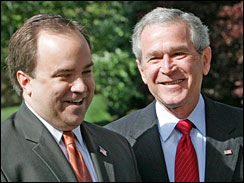
Former White House press secretary Scott McClellan writes in a new memoir that the Iraq war was sold to the American people with a sophisticated 'political propaganda campaign' led by President Bush and aimed at 'manipulating sources of public opinion' and 'downplaying the major reason for going to war.' . . . McClellan includes the charges in a 341-page book, 'What Happened: Inside the Bush White House and Washington's Culture of Deception,' that delivers a harsh look at the White House and the man he served for close to a decade. He describes Bush as demonstrating a 'lack of inquisitiveness,' says the White House operated in 'permanent campaign' mode, and admits to having been deceived by some in the president's inner circle about the leak of a CIA operative's name. . . . The book, coming from a man who was a tight-lipped defender of administration aides and policy, is certain to give fuel to critics of the administration, and McClellan has harsh words for many of his past colleagues. He accuses former White House adviser Karl Rove of misleading him about his role in the CIA case. He describes Secretary of State Condoleezza Rice as being deft at deflecting blame, and he calls Vice President Cheney "the magic man" who steered policy behind the scenes while leaving no fingerprints. . . .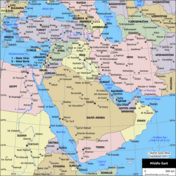 McClellan stops short of saying that Bush purposely lied about his
reasons for invading Iraq, writing that he and his subordinates were not
'employing out-and-out deception' to make their case for war in 2002. . . . But in a chapter titled 'Selling the War,' he alleges that the
administration repeatedly shaded the truth and that Bush 'managed the crisis in
a way that almost guaranteed that the use of force would become the only
feasible option.' . . . 'Over that summer of 2002,' he writes, 'top Bush aides
had outlined a strategy for carefully orchestrating the coming campaign to
aggressively sell the war. . . . In the permanent campaign era, it was all about
manipulating sources of public opinion to the president's advantage.'" To continue reading click here.
The strategy was twofold. First, the reason to go to war involved the neocon desire to revamp the map of the Middle East. According to McClellan, Bush & Company were committed to the oxymoronic term "coercive democracy," the strategy of forcing traditional and tyrannical societies to become democratic or else. With grand Wilsonian irony, the plan envisioned the United States imposing democracy on several nations in the Middle East. But why coercively democratize the Middle East? The answer is simply this: oil and Israel. After all, Kim Jung-il,
the North Korean dictator, has murdered more of his own people than Saddam ever dreamt of doing. But though North Korea actually possesses nuclear weapons, confronting this dictator pays no oil dividends. The second part of the strategy was selling the war to the American people. The neocon conspirators knew their actual motives wouldn't sell on main street. Accordingly, they devised a contrived campaign of smoking guns and mushroom clouds.The White House was livid over the disclosures. 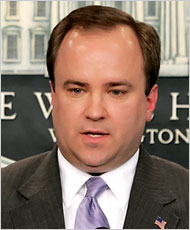 According to the NY Times,
"Mr. McClellan writes that President Bush "convinces himself to believe
what suits his needs at the moment,' and has engaged in
'self-deception' to justify his political ends. He calls the decision
to invade Iraq a 'serious strategic blunder,' and says that the biggest
mistake the Bush White House made was a 'decision to turn away from
candor and honesty when those qualities were most needed.' Mr. Bush's
press secretary, Ms. Dana Perino, who incidentally could not explain
what the 1962 Cuban missile crisis was, took the last resort of a
scoundrel by insisting that Mr. McClellan was 'disgruntled' and wanted
to sell books. Ironically, this is the perfunctory charge McClellan was
told level at other former official who wrote "tell all" books. Click here for the rest of the reaction.
Scott McClellan forges himself a significant place in history with his memoir. We now have the evidence for what we knew from the start. America was radically ill-served by a man with this inordinate capacity to deceive himself and by doing so deceive us as well. There's no greater example of this capacity than a reply Mr. Bush made to a question about Iran's greater power in the area resulting from the invasion. ?To paraphrase, Mr. Bush was incredulous and said Iran has something to fear in the fledgling new democracy growing stronger at the Iranian's doorstep.
Full post as published by Essentially Contested America on May 30, 2008 (boomark / email).
Mexican Style Soft Cheese Recalled
Mexican Style Soft Cheese Recalled due to Possible Listeria Contamination
European Style Smoked Salmon
Recalled due to Possible Listeria Contamination
Trans Ocean
Recalls Cracked Pepper Style Smoked Salmon

#1 Online Legal Resource

On 08-25 at 15:46PM
Acute perpendicular parking #NYPD #NYFD
On 08-18 at 22:18PM
Parallel parking gone bad. Too much gas UES NYC
On 08-18 at 21:41PM
UES NYC
On 08-18 at 21:25PM
Twitter suspends journalist critical of broadcast partner's coverage on dubious grounds @guyadams #nbcfail #twitterfail
On 07-30 at 17:57PM
Model example of 1st Amendment suppression by the People of New York City's Michael Bloomberg #OWS #NYPD
On 07-12 at 21:07PM
AG Holder lackadaisical on Operation in our Sites domain name seizures & RIAA lobbied free speech suppression @dajaz1
On 06-08 at 22:44PM
Why is the Catholic Church going to court over Obama contraception policy? @NewYorker commentary
On 05-31 at 10:08AM
Monks sue Louisiana for right to sell caskets made from forrest destroyed by Katrina
On 05-31 at 07:47AM
Are the abortion ultrasound laws headed for the Supreme Court?
On 05-15 at 21:52PM


 |
|
Contact Us | About Us | Celebrity Law Blog |
Our Partners | Disclaimer
| Law Blog Directory
| Law Jobs
| Law Tweets
| Oil Spill Video
All original material © 1999-2011 by USLaw.com. All other material, including Blog Directory feed content, are © by their respective copyright holders. |