
Home -> Law Blog Directory -> Religion & Law Blogs -> Thoughts in a Haystack
(866) 635-2689 for Personal Injury or (866) 635-9402 for Criminal Defense
Find a Local Lawyer
Divorce (866) 635-6190
Personal Injury (866) 635-2689
Criminal Defense (866) 635-9402

Religion & Law
: Thoughts in a HaystackAping Religion
By John Pieret
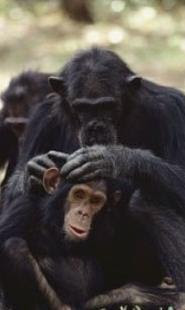 There is a semi-interview in the Toronto Star with Ara Norenzayan, a University of British Columbia psychologist and lead author of a review paper in Science on the role of religion in expanding social traits such as altruism and cooperation beyond kin groups.
The paper argues that social co-operation and altruism conferred an evolutionary advantage as populations grew larger, and that moralizing religions were key to creating large-scale cohesion. ...
Norenzayan says that familial co-operation is understandable because members of the same clans would posses many of the same genes.
"The idea here is that to the extent we are interacting with someone who is genetically related to us, we are going to be altruistic just because it will benefit our (shared) genes to help."
In smaller social groups, he continues, a sense of built-up trust between individuals would allow for longer survival ? and better breeding opportunities ? because an "I scratch your back, you scratch my back" existence can greatly ease life's burdens.
"There is a strong incentive for people ... to get the benefits of co-operation, but not return co-operation and do better than the co-operators," Norenzayan contends. "The best strategy is not to co-operate but pretend to co-operate." ...
"One explanation for why religions have had such a staying power throughout human history and human societies," he says, "is that they play a role in promoting altruistic tendencies in very large groups.
"This is something that is very hard to get."
Thus religious thought, while cultural in origin, meshed ideally with the evolutionary imperative for group co-operation, Norenzayan says.
"Of course it's not a genetic process; it's a cultural process," he says. "But it's feeding back into our evolutionary adaptation and then making possible co-operative tendencies in larger and larger groups."
[Norenzayan] suggests that other, secular mechanisms such as enlightenment-influenced laws, courts and effective policing can serve in place of severed religious regulations.
"There are other ways to be less selfish, more co-operative; you don't have to necessarily have religion to solve that problem."
.
Full post as published by Thoughts in a Haystack on October 04, 2008 (boomark / email).
Walt Disney
alleging a Sikh American applied for a job with Disney but was told he did not have the "Disney look" - apparently referring to his beard and turban, which is required by his religion.

#1 Online Legal Resource

On 08-25 at 15:46PM
Acute perpendicular parking #NYPD #NYFD
On 08-18 at 22:18PM
Parallel parking gone bad. Too much gas UES NYC
On 08-18 at 21:41PM
UES NYC
On 08-18 at 21:25PM
Twitter suspends journalist critical of broadcast partner's coverage on dubious grounds @guyadams #nbcfail #twitterfail
On 07-30 at 17:57PM
Model example of 1st Amendment suppression by the People of New York City's Michael Bloomberg #OWS #NYPD
On 07-12 at 21:07PM
AG Holder lackadaisical on Operation in our Sites domain name seizures & RIAA lobbied free speech suppression @dajaz1
On 06-08 at 22:44PM
Why is the Catholic Church going to court over Obama contraception policy? @NewYorker commentary
On 05-31 at 10:08AM
Monks sue Louisiana for right to sell caskets made from forrest destroyed by Katrina
On 05-31 at 07:47AM
Are the abortion ultrasound laws headed for the Supreme Court?
On 05-15 at 21:52PM


On Scalia and Religion vs. Non-Religion
If You're Interested in Law and Religion,
Pluralism, Religion and the Law
Koppelman on Corruption of Religion
Canadian Constitutional Law #28: Freedom of Religion


 |
|
Contact Us | About Us | Celebrity Law Blog |
Our Partners | Disclaimer
| Law Blog Directory
| Law Jobs
| Law Tweets
| Oil Spill Video
All original material © 1999-2011 by USLaw.com. All other material, including Blog Directory feed content, are © by their respective copyright holders. |