
Home -> Law Blog Directory -> Litigation Blogs -> The FRAUDfiles Blog
(866) 635-2689 for Personal Injury or (866) 635-9402 for Criminal Defense
Find a Local Lawyer
Divorce (866) 635-6190
Personal Injury (866) 635-2689
Criminal Defense (866) 635-9402

Litigation
: The FRAUDfiles BlogThe UFF Money Merge Account fraud
By Tracy Coenen
Today a seller of the United First Financial Money Merge Account product threw out a challenge: Show him how a simple spreadsheet can pay off a mortgage faster than MMA. He said that his client owed $200,000 on a mortgage, and with only $200 “extra” cash left each month after regular living expenses, the MMA product made it possible to pay off that 30 year mortgage in only 13.2 years.
That MMA must be something special!!! No regular person could pay off a mortgage so fast with so little extra money.
I took the reader up on his challenge. I asked for the MMA analysis provided by the software, detailing this 13.2 year payoff. I said that with that data in hand, I’d beat the MMA payoff schedule. In all fairness, I knew when I asked for it that there was funny business involved. It’s not possible to pay off a $200,000 mortgage in less than half of the 30-year payoff schedule with only $200 extra each month applied to the mortgage.
And the data provided proves that UFF and their software is defrauding consumers. Here’s what was in that analysis (click on images to see them full-size):
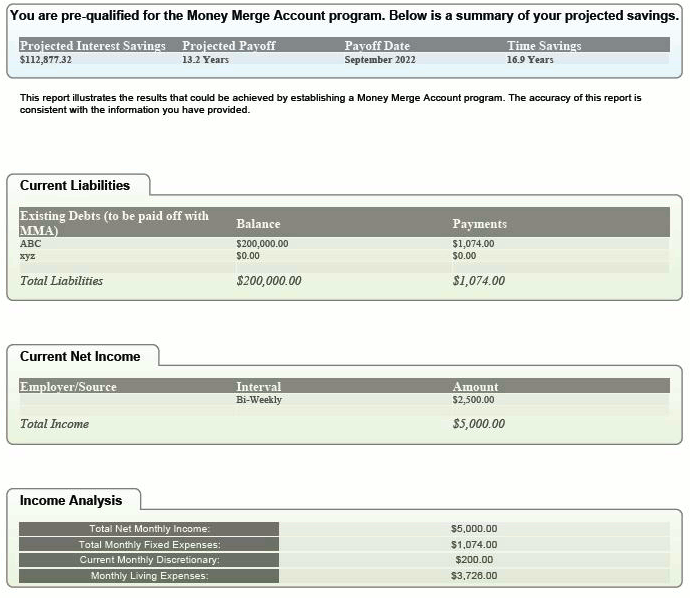
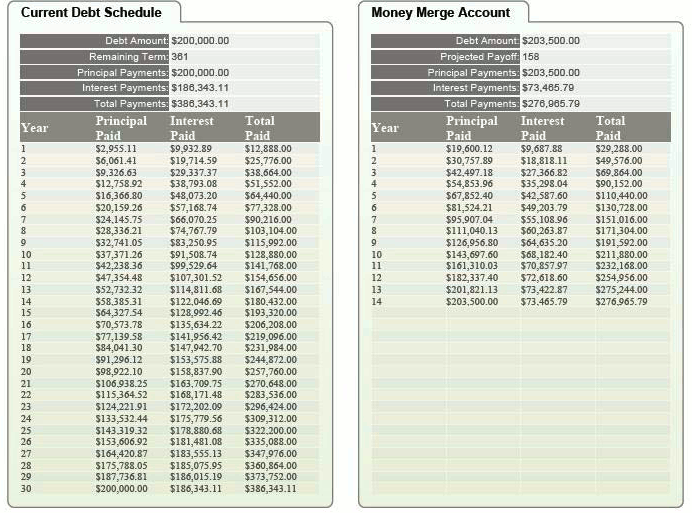
It doesn’t take a trained investigator to spot the fraud in this analysis. In the first graphic, the printout shows $5,000 total monthly income. (That’s actually incorrect, based on the $2,500 bi-weekly income shown above that. The correct figure should be ($2,500 x 26) / 12 = $5,417 per month.)
The printout then shows below that $200 discretionary income each month… implying that the customer has only $200 extra each month to apply to the mortgage.
Except when you scroll down to the side-by-side analysis of before and after the MMA… you see that in year one there is a total paid of $12,888 without MMA, versus $29,288 paid with the MMA. That’s a difference of $16,400 extra paid under the MMA scenario, or almost $1,400 per month? Where did that money come from? The MMA certainly didn’t generate that cash or generate that savings!!!
The MMA seller told me this is where the $1,400 per month comes from. (Please don’t don’t hurt yourself when you fall over laughing.)
MMA does not simply add $200 a month to a client’s mortgage payment (surely only an idiot would pay $3,500 for that); it uses the HELOC’s simple open-interest (pay only for the amount you use) against the mortgage’s amortizing, closed-end interest (100% interest in the beginning; 100% principal at the end). A “5% mortgage” is only a true 5% on its last day because it is all interest for the first several years.
This has the effect of supercharging the $200 discretionary funds; essentially, the client is going to borrow money from the Heloc and make much larger payments to mortgage principal than they otherwise could and then pay off the Heloc draw the next month with employment income and discretionary income. The math algorithms within the software that make those calculations and suggestions are what clients pay for (and as I mentioned, the large amount of commissions paid out by the company for its MLM structure).
Merely a shred of common sense would tell someone that the MMA tool couldn’t magically multiply that $200 each month by seven to make a $1400 extra payment on the mortgage. But the trick MMA uses is to tell the consumer that this is all a result of a “complicated algorithm” that optimizes their money. If you don’t have facts on your side, I guess you’re left to dazzle people with fancy sounding (but false) words.
If you wonder how consumers get conned into wasting $3,500 on this stupid software, it’s easy to see…
- Turning $200 into $1400 each month sounds very enticing.
- Even the company’s own representatives don’t understand what they’re selling and can’t comprehend how wrong the analysis provided to customers is.
The truth is that the money shuffle U1st Financial has people do via the Money Merge Account saves the average consumer about $20 or $30 a month, at best. Any savings beyond that can only come from making extra payments on principal each month… and that money comes straight out of your pocket.
The analysis provided to the consumer by the MMA representative is fraudulent, plain and simple.
©2009Sequence Inc. All Rights Reserved.
.Full post as published by The FRAUDfiles Blog on July 10, 2009 (boomark / email).
How to Skirt H-1B Regulations
Senator reacts to YouTube video
Cell Phone Early Termination Fees
How to recover billing errors
H&R Block Retirement Plan Fraud
How to Join Class Action Suit
Bankrupt Money Manager
Former officers to pay $10.7 million settlement in fraud lawsuit.
Healthcare Payout
Merge to pay $250,000 upon settling derivative lawsuit.
Merge Healthcare Inc.
$16 million settlement reached in consolidated securities class action lawsuit.
Utilities Whistleblower
New Jersey Board of Public Utilities agrees to $485,000 fine for setting up a private bank account.
Money Mart Canada
Settles Class Action for $100 Million
Treasurer Embezzlement
Mary Lou Puccio repays Warren Cheer and Pom Program $26,000 after stealing money.

#1 Online Legal Resource

On 08-25 at 15:46PM
Acute perpendicular parking #NYPD #NYFD
On 08-18 at 22:18PM
Parallel parking gone bad. Too much gas UES NYC
On 08-18 at 21:41PM
UES NYC
On 08-18 at 21:25PM
Twitter suspends journalist critical of broadcast partner's coverage on dubious grounds @guyadams #nbcfail #twitterfail
On 07-30 at 17:57PM
Model example of 1st Amendment suppression by the People of New York City's Michael Bloomberg #OWS #NYPD
On 07-12 at 21:07PM
AG Holder lackadaisical on Operation in our Sites domain name seizures & RIAA lobbied free speech suppression @dajaz1
On 06-08 at 22:44PM
Why is the Catholic Church going to court over Obama contraception policy? @NewYorker commentary
On 05-31 at 10:08AM
Monks sue Louisiana for right to sell caskets made from forrest destroyed by Katrina
On 05-31 at 07:47AM
Are the abortion ultrasound laws headed for the Supreme Court?
On 05-15 at 21:52PM


Eighth Circuit Affirms Dismissal of Securities Fraud Claim Against Merrill Lynch
Securities Fraud: What You Don't Know Can Hurt You
UNH, law school may merge (Portsmouth Herald)
Second Circuit Holds Evidence of Bogus Account Statements is Relevant in Securities Fraud Case


 |
|
Contact Us | About Us | Celebrity Law Blog |
Our Partners | Disclaimer
| Law Blog Directory
| Law Jobs
| Law Tweets
| Oil Spill Video
All original material © 1999-2011 by USLaw.com. All other material, including Blog Directory feed content, are © by their respective copyright holders. |