Home -> Law Blog Directory -> Legal Commentary Blogs -> TalkLeft
(866) 635-2689 for Personal Injury or (866) 635-9402 for Criminal Defense
Find a Local Lawyer
Divorce (866) 635-6190
Personal Injury (866) 635-2689
Criminal Defense (866) 635-9402

Legal Commentary
: TalkLeftSteroid Case: 9th Cir. Rules Seizure of Baseball Players Records Illegal
By Jeralyn
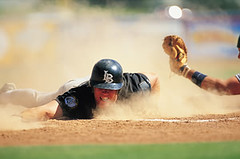
In the baseball steroid cases, the 9th Circuit has issued a lengthy opinion finding the Government violated the 4th Amendment when issuing grand jury subpoenas and search warrants for drug testing records of all tested baseball players.
Investigators looking into steroid use by professional baseball players obtained search warrants and subpoenas for the drug tests results on 10 major league players, but they took the results on 104 players.
The opinion is here. The court provides guidelines for future cases in which the Government is seeking records stored on computers. [More...]
Typically, in seeking these records, the government recites all the ways the records might be disguised on a computer and says it must examine all records to find the ones pertaining to its investigation.
The 9th Circuit says:
We accept the reality that such over-seizing is an inherent part of the electronic search process and proceed on the assumption that, when it comes to the seizure of electronic records, this will be far more common than in the days of paper records. This calls for greater vigilance on the part of judicial officers in striking the right balance between the government’s interest in law enforcement and the right of individuals to be free from unreasonable searches and seizures. The process of segregating electronic data that is seizable from that which is not must not become a vehicle for the government to gain access to data which it has no probable cause to collect.
The guidelines to be used in future cases:
 1. Magistrates should insist that the government waive reliance upon the plain view doctrine in digital evidence cases. See p. 11876 supra.
2. Segregation and redaction must be either done by specialized personnel or an independent third party. See pp.11880-81 supra. If the segregation is to be done by government computer personnel, it must agree in the warrant application that the computer personnel will not disclose to the investigators any information other than that which is the target of the warrant.
3. Warrants and subpoenas must disclose the actual risks of destruction of information as well as prior efforts to seize that information in other judicial fora. See pp. 11877-78, 11886-87 supra.
4. The government’s search protocol must be designed to uncover only the information for which it has probable cause, and only that information may be examined by the case agents. See pp. 11878, 11880-81 supra.
5. The government must destroy or, if the recipient may lawfully possess it, return non-responsive data, keeping the issuing magistrate informed about when it has done so and what it has kept. See p. 11881-82 supra.
....we trust that the procedures we have outlined above will prove a useful tool for the future. In the end, however, we must rely on the good sense and vigilance of our magistrate judges, who are in the front line of preserving the constitutional freedoms of our citizens while assisting the government in its legitimate efforts to prosecute criminal activity. Nothing we could say would substitute for the sound judgment that judicial officers must exercise in striking this delicate balance. 
What is the effect of the opinion?
The decision is a victory for the players' union, which argued for years to have the results destroyed and is still fighting leaks from the material, which was supposed to be anonymous and later was sealed by the courts.
"This was an obvious case of deliberate overreaching by the government in an effort to seize data as to which it lacked probable cause," Chief Judge Alex Kozinski wrote in the 9-2 decision of the 9th U.S. Circuit Court of Appeals.
Barring a last-ditch appeal to the U.S. Supreme Court, the test results and samples will be destroyed, and prosecutors cannot use the information. Union lawyers said the government returned the evidence shortly after earlier trial court rulings.
Full post as published by TalkLeft on August 27, 2009 (boomark / email).
Mitchell Report Summary
Report on Steroid Drug Use in Major League Baseball by Senator George Mitchell
Illegal Immigrant Responsibility and Reform Act of 1996
Explanation of the controversial illegal immigration law
Discouraging Union Organizers
Strict work place rules
Baseball Players Named in Mitchell Report
Major League Baseball Players using Performance Enhancing Drugs
VA Sets New Benefit Rules for Agent Orange-Related Ilnesses
Agent Orange-Related Ilnesses VA Sets New Benefit Rules
Medical Records
To Stay out of Pharma's Hands
DVD Players Recalled by Wal-Mart Due to Fire Hazard
DVD Players Recalled by Wal-Mart Due to Fire Hazard
NCAA
Men's Basketball, Football Players Settle Class Action for $228 Million
NCAA
Faces Antitrust Class Action over use of Players' Images
Forest Laboratories Potentially Illegal Marketing
Forest Laboratories Potentially Illegal Marketing

#1 Online Legal Resource

On 08-25 at 15:46PM
Acute perpendicular parking #NYPD #NYFD
On 08-18 at 22:18PM
Parallel parking gone bad. Too much gas UES NYC
On 08-18 at 21:41PM
UES NYC
On 08-18 at 21:25PM
Twitter suspends journalist critical of broadcast partner's coverage on dubious grounds @guyadams #nbcfail #twitterfail
On 07-30 at 17:57PM
Model example of 1st Amendment suppression by the People of New York City's Michael Bloomberg #OWS #NYPD
On 07-12 at 21:07PM
AG Holder lackadaisical on Operation in our Sites domain name seizures & RIAA lobbied free speech suppression @dajaz1
On 06-08 at 22:44PM
Why is the Catholic Church going to court over Obama contraception policy? @NewYorker commentary
On 05-31 at 10:08AM
Monks sue Louisiana for right to sell caskets made from forrest destroyed by Katrina
On 05-31 at 07:47AM
Are the abortion ultrasound laws headed for the Supreme Court?
On 05-15 at 21:52PM


En Banc 9th to Decide If Feds May Use Steroid Tests of Pro Baseball Players
Steroids are a Danger to the Players as Well as to the Game
Alex Rodriguez' (and 93 others') drug test results were unjustly seized
Hall of Fame, Steroids, and Cheating
Investigators can use baseball players' drug tests, 9th Circuit rules


 |
|
Contact Us | About Us | Celebrity Law Blog |
Our Partners | Disclaimer
| Law Blog Directory
| Law Jobs
| Law Tweets
| Oil Spill Video
All original material © 1999-2011 by USLaw.com. All other material, including Blog Directory feed content, are © by their respective copyright holders. |