
Home -> Law Blog Directory -> Legal Commentary Blogs -> Balkinization
(866) 635-2689 for Personal Injury or (866) 635-9402 for Criminal Defense
Find a Local Lawyer
Divorce (866) 635-6190
Personal Injury (866) 635-2689
Criminal Defense (866) 635-9402

Legal Commentary
: BalkinizationSummer reading: new books on prohibition, the Founders, and more
By Jack M. Balkin
The 18th Amendment gets a new history in LAST CALL: The Rise and Fall of Prohibition by Daniel Okrent, reviewed today in the New York Times. "On Jan. 17, 1920, America went dry," David Oshinsky writes. "The 18th Amendment had been ratified a year earlier, ba nning 'the manufacture, sale, or transportation of intoxicating liquors' within the United States and its territories. Thus began the era of Prohibition, a nearly 14-year orgy of lawbreaking unparalleled in our history." Okrent
views Prohibition as one skirmish in a larger war waged by small-town white Protestants who felt besieged by the forces of change then sweeping their nation - a theory first proposed by the historian Richard Hofstadter more than five decades ago. Though much has been written about Prohibition since then, Okrent offers a remarkably original account, showing how its proponents combined the nativist fears of many Americans with legitimate concerns about the evils of alcohol to mold a movement powerful enough to amend the United States Constitution.The rest is here.
"Refreshingly accessible and deeply informed," Revolutionaries: A New History of the Invention of America by Jack Rakove "is just what you need when someone on the Internet or cable TV offers to give you the ideas about history now being offered by the Tea Party movement in exchange for those you got from well-trained teachers," David Hollinger writes in the San 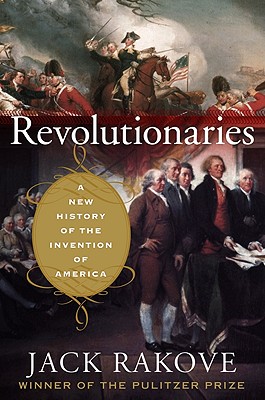 Francisco Chronicle. (The internet and well-trained teachers are, of course, not in separate worlds.) Hollinger continues:
The Federalist Papers an argument against a strong federal government that undercuts the policies of the Obama administration? Tea Party leader Dick Armey of Texas made this claim recently. When a skeptical reporter asked him about Alexander Hamilton, the chief author of the Federalist Papers, Armey declared that only "ill-informed professors" thought Hamilton was an advocate of a powerful national state. Ah, yes, professors.Continue reading here."Revolutionaries" is written by a distinguished professor at Stanford who, unlike Dick Armey, knows the difference between a federalist and an anti-federalist....
But "Revolutionaries" is much more than a convenient inventory of truths by which the Tea Party version of the founding can be refuted. While Rakove does provide us with a cogent summary of what scholars know about the political history of the late 18th century, what gives his book real distinction is the skill with which he delivers this knowledge through a series of interlocking biographical narratives.
For law & war scholars: "How authentic can a war be when things don't blow up?" asks Jeff Stein in a Washington Post review of CYBER WAR: The Next Threat to National Security and What to Do About It by Richard A. Clarke and Robert K. Knake. "But the utility of cyber-tools in service of old-fashioned firepower ha[s] already been made clear." Nevertheless, "U.S. presidents have treated cyber-defense like spinach, picking it up and then putting it down....It will probably take 'an electronic Pearl Harbor' to wake us up, Clarke says."
Also reviewed this week: At the Edge of the Precipice: Henry Clay and the Compromise that Saved the Union by Robert V. Remini is discussed in The New Republic. The New York Times takes up THE BEAUTY BIAS: The Injustice of Appearance in Life and Law by Deborah L. Rhode, MAKING HASTE FROM BABYLON: The Mayflower Pilgrims and Their World: A New History by Nick Bunker, and THE LAST HERO: A Life of Henry Aaron by Howard Bryant. Cross-posted from the Legal History Blog.

Full post as published by Balkinization on May 23, 2010 (boomark / email).

#1 Online Legal Resource

On 08-25 at 15:46PM
Acute perpendicular parking #NYPD #NYFD
On 08-18 at 22:18PM
Parallel parking gone bad. Too much gas UES NYC
On 08-18 at 21:41PM
UES NYC
On 08-18 at 21:25PM
Twitter suspends journalist critical of broadcast partner's coverage on dubious grounds @guyadams #nbcfail #twitterfail
On 07-30 at 17:57PM
Model example of 1st Amendment suppression by the People of New York City's Michael Bloomberg #OWS #NYPD
On 07-12 at 21:07PM
AG Holder lackadaisical on Operation in our Sites domain name seizures & RIAA lobbied free speech suppression @dajaz1
On 06-08 at 22:44PM
Why is the Catholic Church going to court over Obama contraception policy? @NewYorker commentary
On 05-31 at 10:08AM
Monks sue Louisiana for right to sell caskets made from forrest destroyed by Katrina
On 05-31 at 07:47AM
Are the abortion ultrasound laws headed for the Supreme Court?
On 05-15 at 21:52PM


Three cheers for summer reading
Summer reading: the books that should appeal to lawyers
The Best End-of-Summer Books for GCs


 |
|
Contact Us | About Us | Celebrity Law Blog |
Our Partners | Disclaimer
| Law Blog Directory
| Law Jobs
| Law Tweets
| Oil Spill Video
All original material © 1999-2011 by USLaw.com. All other material, including Blog Directory feed content, are © by their respective copyright holders. |