
Home -> Law Blog Directory -> Intellectual Property Law Blogs -> IPKat
(866) 635-2689 for Personal Injury or (866) 635-9402 for Criminal Defense
Find a Local Lawyer
Divorce (866) 635-6190
Personal Injury (866) 635-2689
Criminal Defense (866) 635-9402

Intellectual Property Law
: IPKatAdded matter, intermediate generalisation and a good day for cricket
By Johanna Gibson, David Pearce, Jeremy Phillips and Ilanah Simon.
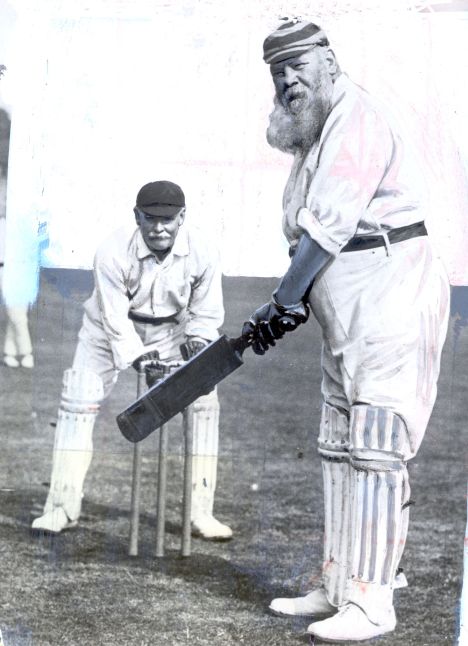 After a tennis-related post earlier this morning, it is tempting to link this article to another of England's frequently rain-affected summer sports, cricket. Sadly, this doesn't quite work. The Grace in this case is not the legendary WG Grace (right) by the presumably unrelated WR Grace -- it's a patent-y sort of case with lots of facts and not a huge amount of intelligible law. The case in question, decided by Mr Justice Floyd yesterday in the Patents Court, England and Wales, is Fosroc International Ltd v WR Grace & Co.-Conn [2010] EWHC 1702 (Ch), and it's largely about added subject matter.
* When considering whether a proposed amendment added any matter to the patent, the court had to see first what was disclosed in the patent and then look at what was disclosed in the patent as amended. It should then compare the two disclosures and decide whether any subject matter relevant to the invention had been added [No rocket science here, in principle at any rate: it looks like a simple subtraction exercise].* If the specification discloses distinct subclasses of the overall inventive concept, it should be possible to amend by whittling the patent down to one or more of those subclasses, regardless of whether they were presented as inventively distinct in the specification before amendment.* when a proposed amendment seeks to take features which are only disclosed in one particular context and which are not disclosed as having any inventive significance, introducing them into a claim which is not limited by that context, we have "intermediate generalisation", a subtle, sneaky form of extended subject matter which has to be watched out for.

Full post as published by IPKat on July 13, 2010 (boomark / email).
Lighter Blamed in House Fire
Cricket Lighters settles $200,00 wrongful death lawsuit.
Explicit E-Mail
Adult website fined $413,000 in explicit e-mail matter.

#1 Online Legal Resource

On 08-25 at 15:46PM
Acute perpendicular parking #NYPD #NYFD
On 08-18 at 22:18PM
Parallel parking gone bad. Too much gas UES NYC
On 08-18 at 21:41PM
UES NYC
On 08-18 at 21:25PM
Twitter suspends journalist critical of broadcast partner's coverage on dubious grounds @guyadams #nbcfail #twitterfail
On 07-30 at 17:57PM
Model example of 1st Amendment suppression by the People of New York City's Michael Bloomberg #OWS #NYPD
On 07-12 at 21:07PM
AG Holder lackadaisical on Operation in our Sites domain name seizures & RIAA lobbied free speech suppression @dajaz1
On 06-08 at 22:44PM
Why is the Catholic Church going to court over Obama contraception policy? @NewYorker commentary
On 05-31 at 10:08AM
Monks sue Louisiana for right to sell caskets made from forrest destroyed by Katrina
On 05-31 at 07:47AM
Are the abortion ultrasound laws headed for the Supreme Court?
On 05-15 at 21:52PM


Cricket Communications Cricket EZ Cellular Phones due to problems with 911 calls
India, International Cricket Battle Over Contracts
Cricket and Hipcricket Settle Trademark Infringement Lawsuit
Child porn cricket coach jailed - BBC News


 |
|
Contact Us | About Us | Celebrity Law Blog |
Our Partners | Disclaimer
| Law Blog Directory
| Law Jobs
| Law Tweets
| Oil Spill Video
All original material © 1999-2011 by USLaw.com. All other material, including Blog Directory feed content, are © by their respective copyright holders. |