
Home -> Law Blog Directory -> Intellectual Property Law Blogs -> IPKat
(866) 635-2689 for Personal Injury or (866) 635-9402 for Criminal Defense
Find a Local Lawyer
Divorce (866) 635-6190
Personal Injury (866) 635-2689
Criminal Defense (866) 635-9402

Intellectual Property Law
: IPKatDo poor people like different patents to rich people?
By Johanna Gibson, David Pearce, Jeremy Phillips and Ilanah Simon.
 That is the question - simplified - posed by a new paper by the economist Christian Kiedaisch of the ETH Zurich. The paper examines distributional implications of different patent policies. The proposed mechanism is that an increase in patent length increases the share of monopolized industries so that relatively more goods are sold at a markup. However, markups decrease in the share of monopolized industries and the rich benefit more from this effect than the poor as they consume a larger share of patented goods than the poor. While both the rich and the poor benefit in a similar way from an increase in the rate of growth, the poor loose more in terms of current consumption than the rich if patent length increases and because of that, they prefer shorter patents.
The author then examines the preference for another quality of patents which he terms "patent breadth", roughly capturing the deterrent effect of patents on entry into the market (scope of protection and ease of enforcement). He concludes that an increase in patent breadth increases innovation incentives so that a given rate of growth can be attained with long and narrow or short and broad patents (lawyers' toenails tend to curl when the scope of protection of a patent is thus simplified...). If the relative per capita labour income of the poor is not too large, they prefer short and broad patents while the rich prefer long and narrow patents. If, on the other hand, the poor are so poor that they can only afford to consume nonpatented goods, they are in favour of stronger patent protection which leads to a larger rate of growth.
As you can imagine, the whole thing is a lot more technical and complicated than this short post, so read the paper if your curiosity has been piqued.
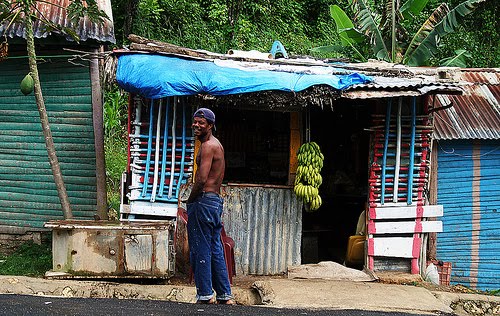
The image is a creative-commons licensed photo of a street scene in Haiti by Michelle Brea- hanging on- . I wonder whether the depicted guy prefers short and broad patents or is in favour of stronger patent protection...

Full post as published by IPKat on July 27, 2010 (boomark / email).
Mars Petfood
79 People Sick So Far
Salmonella Outbreak
50 People Sick in Five States
Sudan Plane Crash
100 People Believed Dead
Chemical Companies
alleging danger to people living near the plants.
Cipro
The FDA is seeking to add black box warnings of the risk of tendon rupture associated with Cipro and Levaquin.
The ruptures can involve Achilles tendon, shoulder, hand, bicep or thumb tendons, and is especially increased in patients older than 60, or people who have received kidney, heart or lung transplants, as well as people on steroid therapy...
Clearwire Service
alleging poor quality and unfairly charging early termination fees.

#1 Online Legal Resource

On 08-25 at 15:46PM
Acute perpendicular parking #NYPD #NYFD
On 08-18 at 22:18PM
Parallel parking gone bad. Too much gas UES NYC
On 08-18 at 21:41PM
UES NYC
On 08-18 at 21:25PM
Twitter suspends journalist critical of broadcast partner's coverage on dubious grounds @guyadams #nbcfail #twitterfail
On 07-30 at 17:57PM
Model example of 1st Amendment suppression by the People of New York City's Michael Bloomberg #OWS #NYPD
On 07-12 at 21:07PM
AG Holder lackadaisical on Operation in our Sites domain name seizures & RIAA lobbied free speech suppression @dajaz1
On 06-08 at 22:44PM
Why is the Catholic Church going to court over Obama contraception policy? @NewYorker commentary
On 05-31 at 10:08AM
Monks sue Louisiana for right to sell caskets made from forrest destroyed by Katrina
On 05-31 at 07:47AM
Are the abortion ultrasound laws headed for the Supreme Court?
On 05-15 at 21:52PM


Acting Against ACTA by Professor Alan Story
Alaska Republicans: Poor People Worth Less Than Rich People...
Two Florida cities among America's most unequal cities
Student Blogger - Can Charities Be Too Rich
Debtors' Prisons and the Rights of the Poor
An Argument For Fox News Polls


 |
|
Contact Us | About Us | Celebrity Law Blog |
Our Partners | Disclaimer
| Law Blog Directory
| Law Jobs
| Law Tweets
| Oil Spill Video
All original material © 1999-2011 by USLaw.com. All other material, including Blog Directory feed content, are © by their respective copyright holders. |