Home -> Law Blog Directory -> Media & Entertainment Law Blogs -> Sports Law Blog
(866) 635-2689 for Personal Injury or (866) 635-9402 for Criminal Defense
Find a Local Lawyer
Divorce (866) 635-6190
Personal Injury (866) 635-2689
Criminal Defense (866) 635-9402

Media & Entertainment Law
: Sports Law BlogRevisiting Electronic Arts' Exclusive Contract with the NFL and NFLPA
By Rick Karcher, Michael McCann, Geoffrey Rapp, Greg Skidmore, and Howard Wasserman
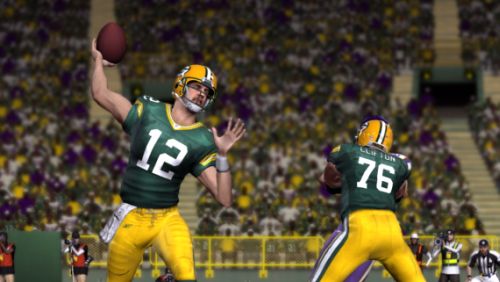 Back in 2004, I wrote about Electronic Arts snagging an exclusive licensing contract with the NFL and NFLPA to develop, publish, and distribute football video games featuring NFL players and teams. The 5-year, $400 million contract--the exclusivity of which resembles the exclusive NFL-Reebok contract that precipitated American Needle v. NFL--meant the end of other third-party publishers making NFL video games. Most notably, it meant that Sega's popular/arguably better and substantially cheaper NFL 2K series would be discontinued while Electronic Arts' John Madden Football would become the only NFL game in town.
Since then, the exclusive contract has been extended to 2012 and John Madden Football has been published each year, with annual updates to player rosters and, some would argue, only modest enhancements to game play. Nonetheless, each year's iteration of Madden Football tends to attract reasonably favorable reviews and sell quite well.
I wrote about this topic and related litigation in my Yale Law Journal article "American Needle. v. NFL: An Opportunity to Reshape Sports Law":
Although Electronic Arts' NFL games have sold well since 2004, they have attracted criticism for lacking innovation. Prices for Madden NFL games have also risen in the absence of competition from other NFL games. Those and other consequences underscore a central concern of section 1: an absence of competition will lead to an inferior market. The exclusive Madden contract is also the subject of Pecover v. Electronic Arts, a class action lawsuit recently brought by disenchanted video game players. The suit contains a number of claims, including those based on the Sherman Act. While neither the NFL nor the NFLPA is a party to the litigation, their exclusive contract with Electronic Arts could eventually face a section 1 challenge similar to the one confronted by the NFL in American Needle. Plaintiffs in such a claim would likely assert that interactive football video game software is a sufficiently discrete product market - a proposition supported by the U.S. District Court for the Northern District of California in Pecover. With some level of persuasion in light of the aforementioned data on prices and commentary on innovation, the plaintiffs could also maintain that Electronic Arts's exclusive contract for NFL video games produces more anticompetitive injury than procompetitive benefit.In an interview with RipTen, Marc Eldeman also discusses these issues. Also, Pecover v. Electronic Arts remains in litigation, with its lead attorney confident that the plaintiffs will prevail.
Fast forward to 2011, IGN's Hilary Goldstein takes a critical view of the exclusive NFL contract with Electronic Arts. Here's an excerpt of his article, which hits at two concerns antitrust law has for exclusive contracts: higher prices and diminished innovation.
I have little doubt the Madden series would be considerably better if [Electronic Arts] developer Tiburon had a competitor threatening it each year . . . Does Madden NFL 11 play better than Madden NFL 2005? Yes. There's no question that, over time, the gameplay has seen improvements thanks to better animations and smarter AI. But because there is no one else to stand up against it, Tiburon can schedule its innovations at its leisure. . . .To read the rest of Goldstein's article, click here.I don't expect Tiburon to start taking big chances and making more exciting and more substantial improvements. Why would they? And that's what sets the Madden series apart from the majority of other games. No one can rightly compete, because the NFL license is football and EA holds onto it tightly.
Sure, Microsoft owns the Halo license, but anyone has a right to make a first-person shooter and it can legitimately stand on its own. You can't make a football game without the NFL teams and players. It's an automatic fail.

Full post as published by Sports Law Blog on February 05, 2011 (boomark / email).
Uniform Commercial Code and Contracts
Interstate commercial transactions and sale of goods in the United States
Employment Contracts
General Contract Law Principles
FDA
Warns About Electronic Cigarettes
MEMC Electronic Materials Inc
401(k) / ERISA Stock Fraud
Polaris All-Terrain Vehicles
Defective Electronic Control Modules
Electronic Data Systems Corp.
allegedly failed to pay employee overtime.
Baxter Electronic Infusion Pumps
FDA Issues Urgent Class I Recall
AnchorBank
$1.27 million in construction contract termination lawsuit.

#1 Online Legal Resource

On 08-25 at 15:46PM
Acute perpendicular parking #NYPD #NYFD
On 08-18 at 22:18PM
Parallel parking gone bad. Too much gas UES NYC
On 08-18 at 21:41PM
UES NYC
On 08-18 at 21:25PM
Twitter suspends journalist critical of broadcast partner's coverage on dubious grounds @guyadams #nbcfail #twitterfail
On 07-30 at 17:57PM
Model example of 1st Amendment suppression by the People of New York City's Michael Bloomberg #OWS #NYPD
On 07-12 at 21:07PM
AG Holder lackadaisical on Operation in our Sites domain name seizures & RIAA lobbied free speech suppression @dajaz1
On 06-08 at 22:44PM
Why is the Catholic Church going to court over Obama contraception policy? @NewYorker commentary
On 05-31 at 10:08AM
Monks sue Louisiana for right to sell caskets made from forrest destroyed by Katrina
On 05-31 at 07:47AM
Are the abortion ultrasound laws headed for the Supreme Court?
On 05-15 at 21:52PM


Two Gamers File Class Action Lawsuit Against Electronic Arts
RETIRED NFL PLAYERS V. MADDEN AND ELECTRONIC ARTS
ELECTRONIC ARTS SUED OVER "WIN WITH THE REBELS"
Bebchuk v. Electronic Arts: Dismissed
Electronic Arts Bids for Take-Two


 |
|
Contact Us | About Us | Celebrity Law Blog |
Our Partners | Disclaimer
| Law Blog Directory
| Law Jobs
| Law Tweets
| Oil Spill Video
All original material © 1999-2011 by USLaw.com. All other material, including Blog Directory feed content, are © by their respective copyright holders. |